
Big Gains, Growing Strains
Big Gains, Growing Strains:
Public Higher Education Funding After the Fair Share Amendment
Executive Summary
This decade, Massachusetts has made one of the most significant investments in public higher education in a generation. Following the passage of the Fair Share Amendment in 2022, which added billions to state coffers, the Commonwealth directed a portion of these new revenues toward expanding student financial aid. This included launching a universal tuition-free community college program and expanding existing tuition-free programs at public four-year institutions, with the goal of increasing student access.
Massachusetts has expanded access to public higher education; the challenge now is ensuring that these new opportunities translate into higher levels of degree attainment, workforce development, and economic mobility.
The results are visible:
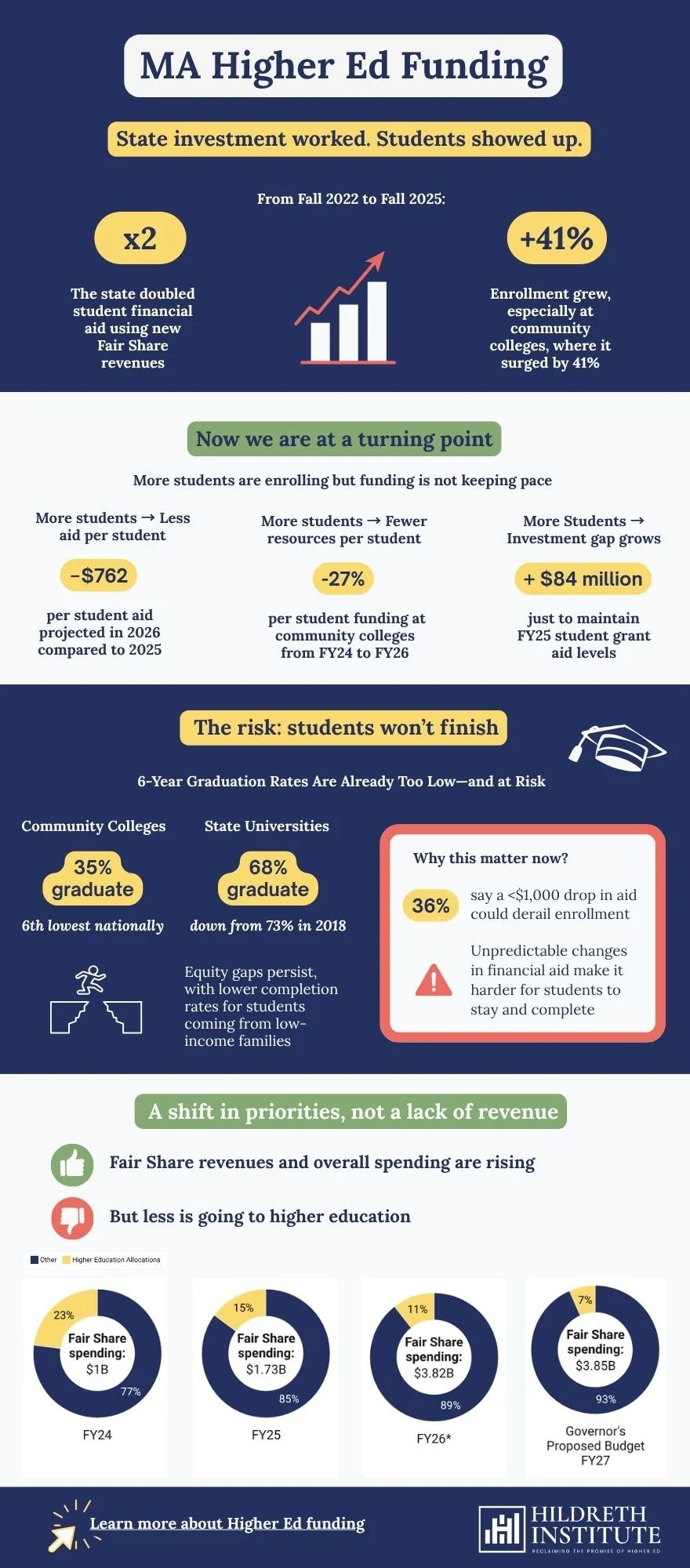
State financial aid more than doubled within a few years of Fair Share implementation.
In-state community college enrollment increased by 41 percent between fall 2022 and fall 2025, returning to pre-pandemic levels. This increase reflects a Massachusetts-specific rebound rather than a national trend, as community college enrollment nationally has recovered only modestly since the pandemic.
Enrollment declines at state universities and UMass have stabilized after a decade of contraction.
Yet important policy questions now emerge: will these investments translate into more degrees and stronger economic opportunities for Massachusetts residents? And are current funding levels sufficient to sustain that progress?
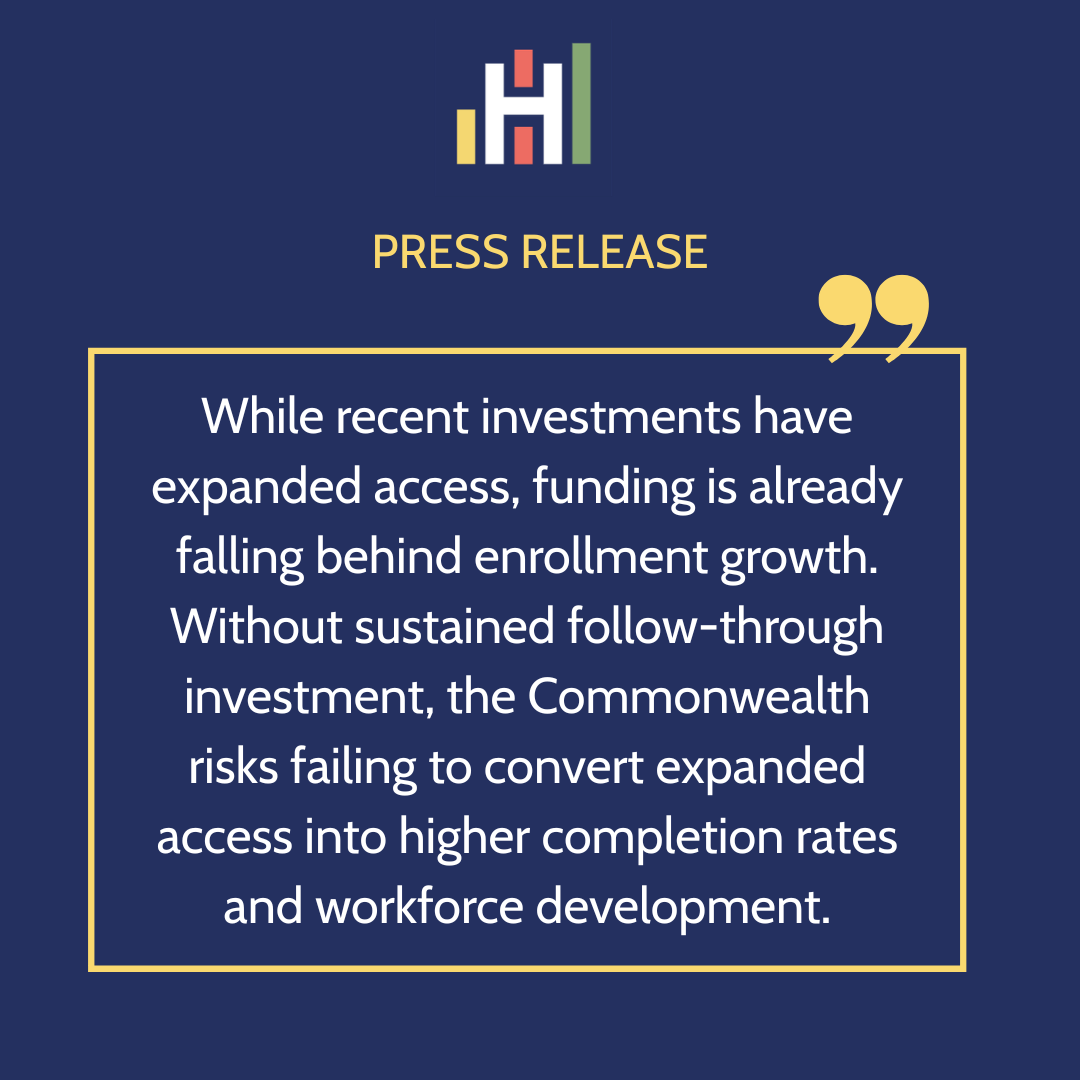
This report shows that while recent investments have expanded access, funding is already falling behind enrollment growth. Without sustained follow-through investment, the Commonwealth risks failing to convert expanded access into higher completion rates and workforce development.
Fair Share revenues are growing, yet the share directed to higher education has declined. This represents a missed opportunity to invest those revenues in the next phase of reform: ensuring that expanded college access translates into higher completion rates and economic mobility through sustained investments in financial aid stability, instructional capacity, and student success initiatives.
In FY2024, approximately 23 percent of available Fair Share revenues were directed to higher education. As total collections increased in subsequent years, allocations did not grow proportionally, reducing higher education’s share to 11 percent in FY2026, and lower still in the Governor’s FY2027 proposal. This shift reflects a change in allocation priority rather than a constraint in available revenue, indicating that additional investment in higher education remains fiscally feasible within the Fair Share framework.
Emerging Risks
Student financial aid appropriations are already falling behind enrollment growth, putting the stability of the tuition-free access and stipend promise at risk. State financial aid appropriations declined by approximately $26 million from FY2025 to FY2026. Combined with continued enrollment growth, this reduction is projected to lower per-student grant aid by $762.
Maintaining current per-student financial aid levels will require sustained investment. To maintain FY2025 financial aid levels on a per-student basis in FY2026, total state appropriations would need to increase by over $84 million.
Operational funding per student is declining at community colleges. After peaking in FY2024, inflation-adjusted operational spending per student fell by 27 percent over two fiscal years as enrollment rose faster than campus funding.
Community colleges remain funded at substantially lower levels per student than public four-year institutions. Despite enrolling a disproportionate share of low-income and first-generation students, community colleges receive roughly half the per-student operational funding of state universities and significantly less than UMass campuses.
Targeted student support programs are not keeping pace with enrollment growth nor expanding to the scale of completion challenges. Student success initiatives, such as structured advising, academic coaching, and wraparound services that help students remain enrolled and complete their degrees, remain limited in scale relative to need. This gap is particularly consequential at community colleges, where enrollment has risen sharply following tuition-free policies but completion outcomes remain a significant challenge: only 35.2 percent of Massachusetts community college students earn a degree within six years, ranking the state sixth lowest nationally. Completion rates at state universities have also declined across recent cohorts and equity gaps persist, with six-year graduation rates at 56.8 percent for Black students and 56.6 percent for Latino students, compared with 72.3 percent for White students.
Recent investments have meaningfully expanded access to public higher education, particularly through tuition-free community college. But access alone will not deliver the full promise of these investments. Early funding pressures suggest that financial aid, institutional capacity, and student support are already lagging behind enrollment growth, putting completion and workforce goals at risk.
The next phase of this agenda is ensuring that students can persist and complete their programs. As Fair Share revenues continue to grow, recommitting at least 25 percent of collections to higher education would help funding keep pace with demand and strengthen the supports needed to turn expanded access into higher completion rates and stronger workforce outcomes.
SUCCESS provides advising, coaching, peer mentoring, affinity groups, tutoring, and other student support services focused primarily on academic and developmental supports that help students navigate coursework and institutional processes.
Why This Matters Now
Despite efforts to improve college outcomes for students, especially those from historically marginalized communities, completion rates remain stubbornly low in Massachusetts: the state ranks 6th lowest nationally for six-year community college graduation rates. Only 35.2% of students earn a degree within six years, a rate that has stagnated since 2018 and is about 20% lower than the national average (43.8%).
Learn More